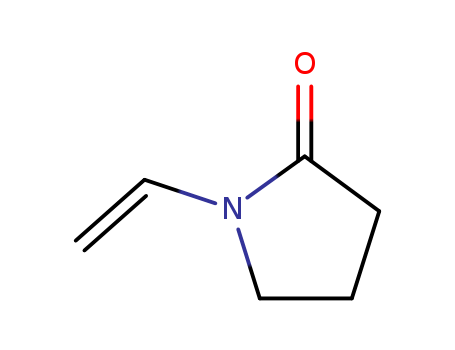
N-Vinylpyrrolidone (NVP) is an important organic compound and functional monomer with the chemical formula C₆H₉NO, molecular weight 111.14, and CAS number 88-12-0.
Primarily used in rapid processing and low-temperature processes for protecting cables, electrical equipment, printed circuit boards, etc.
Applied to enhance elongation and viscosity in low-gloss coatings, improve wood performance, reduce environmental pollution pressure, and maintain curing properties in paper production.
Mainly utilized in metal diluents, cured inks, and cured adhesives.
|
Item |
Powder |
Solution |
|
Premium Grade |
Standard Grade |
|
|
Appearance |
White to pale yellow powder |
Colorless to pale yellow, clear, viscous solution |
|
K-value |
85–115% of labeled value (if K ≤ 15); 90–108% (if K > 15) |
— |
|
Residual NVP (%) |
≤0.01 |
≤0.05 |
|
Moisture (%) |
≤5.0 |
— |
|
Solid Content (%) |
— |
— |
|
pH (5% aqueous sol.) |
3.0–7.0 |
— |
|
Sulfate Ash (%) |
≤0.10 |
— |
|
General Description |
1-Vinyl-2-pyrrolidinone is a colorless to yellow liquid, with a characteristic odor. Its melting point is around 13.5oC and boils at about 90-92oC. VP is completely miscible in water and in most organic solvents but partially miscible in aliphatic hydrocarbons. Industrial production of VP by reacting 2-pyrrolidone with acetylene at high pressure and temperature has been reported. The vinylation process proceeds in liquid phase and is catalyzed by 3-pyrrolidone -potassium hydroxide. |
|
Safety Profile |
Confirmed carcinogen. Moderately toxic by ingestion, inhalation, and skin contact. A severe eye irritant. Probably irritating and narcotic in high concentrations. Combustible when exposed to heat or flame; can react vigorously with oxibzing materials. To fight fire, use alcohol foam, CO2, dry chemical. When heated to decomposition it emits highly toxic fumes of NOx. |
InChI:InChI=1/C6H9NO/c1-2-7-5-3-4-6(7)8/h2H,1,3-5H2
Process to produce N-vinyl compounds by ...
The vinylation of various nucleophiles w...
The reaction of cyclic amides with acety...
The production of monomers from bio-base...
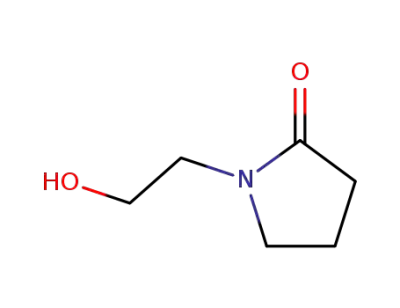
1-(2-hydroxyethyl)-2-pyrrolidinone

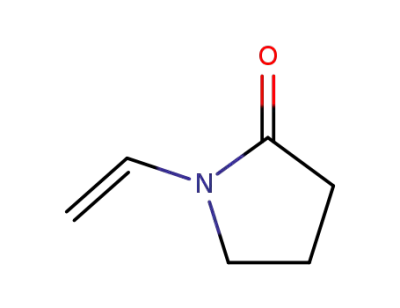
1-ethenyl-2-pyrrolidinone
| Conditions | Yield |
|---|---|
|
With Na/SiO2; ammonia; at 350 ℃; for 10h; under 750.075 Torr; Reagent/catalyst; Temperature; Catalytic behavior;
|
90% |
|
Ca/Zn oxide; at 348 ℃; for 1h;
|
82% |
|
Ca/Zn oxide; at 331 - 359 ℃; for 1h;
|
67.5% |
|
zinc-magnesium mixed oxide; at 356 - 360 ℃; for 2 - 4h;
|
66.7% |
|
Ca/Zn oxide calcined in air to 500 C; at 366 ℃; for 1h;
|
44% |
|
magnesium oxide; at 368 ℃; for 1h;
|
26.6% |
|
Ca/Zn oxide calcined in air to 700 C; at 359 ℃; for 1h;
|
11.5% |
|
calcium carbonate; at 377 ℃; for 1h;
|
2.7% |
|
With aluminum oxide; at 300 - 340 ℃; under 56 Torr; Beim Leiten des Dampfes von Edukt ueber Reagens;
|
|
|
Multi-step reaction with 2 steps
1: benzene; thionyl chloride
2: benzene; sodium amide
With thionyl chloride; sodium amide; benzene;
|
|
|
With Cs2O#SiO2; at 500 ℃; for 2h;
|
|
|
Gas phase;
|
|
|
With Cs1Si10 catalyst; for 1h; under 760.051 Torr; Inert atmosphere; Sealed tube;
|
87 %Chromat. |
|
With sodium oxide-silicon dioxide; at 350 ℃; Temperature; Catalytic behavior; Flow reactor; Green chemistry;
|
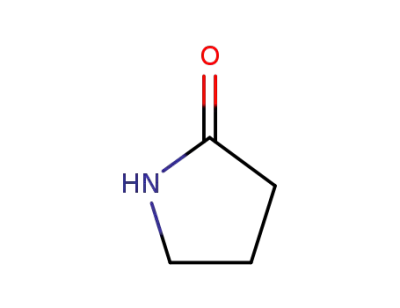
2-pyrrolidinon

![[1,3]-dioxolan-2-one](/upload/2026/5/14fd29e9-84f4-4ada-be6a-bcd0109db6b9.png)
[1,3]-dioxolan-2-one
1-ethenyl-2-pyrrolidinone
| Conditions | Yield |
|---|---|
|
With TEMPOL; 1,8-diazabicyclo[5.4.0]undec-7-ene; In 5,5-dimethyl-1,3-cyclohexadiene; at 100 - 120 ℃; for 3.5h; Dean-Stark;
|
82.13% |
2-pyrrolidinon

1-(2-chloro-ethyl)-pyrrolidin-2-one
1-(2-hydroxyethyl)-2-pyrrolidinone

N-trimethylsilyl-pyrrolidin-2-one
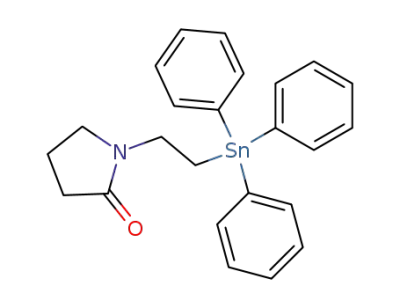
{2-(2-oxo-N-pyrrolidinyl)ethyl}triphenyltin

3-benzoyl-N-vinylpyrrolidin-2-one
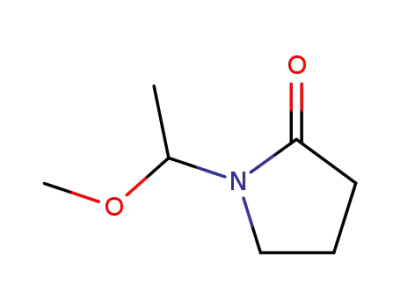
1-(1-Methoxyethyl)-2-pyrrolidinon
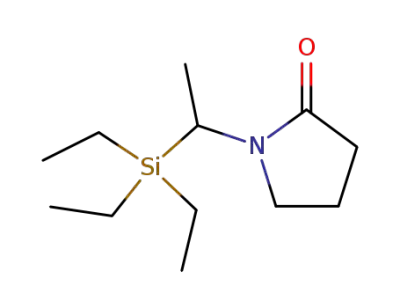
1-(pyrrolidinyl-2-on-1-yl)-1-triethylsilylethane
For inquiries About Our Products, Please Leave Your E-Mail To Us And We will Contact You Within 24 Hours.

Address:Xingcun Road, Xinfeng County Industrial Park, Ganzhou City, Jiangxi Province E-mail:contactus@gzznsy.cn
Tel:+86 7973396425 Phone:13988304234